Why engineers still edit G-code after slicing
A generated toolpath can be followed by another round of manual work, and that is one of the preparation steps we are looking at closely.
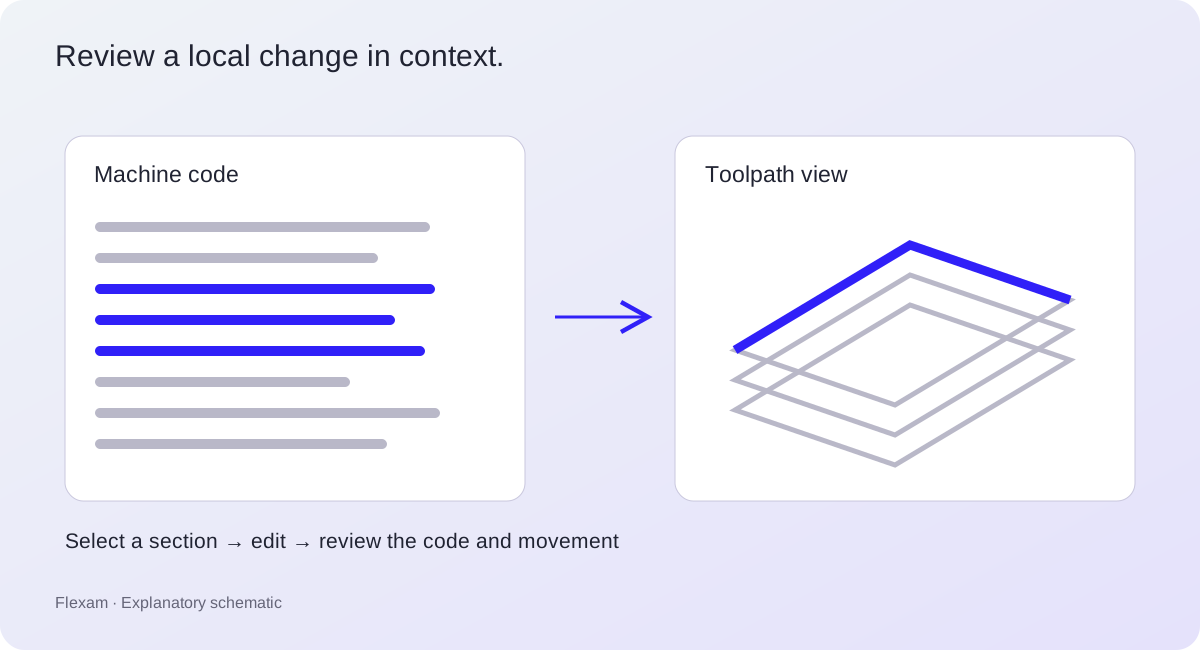
The work after generating the path
In June, we asked additive-manufacturing teams a direct question: do you edit your G-code before printing? We had been speaking with people whose work continued after the toolpath had been generated. They checked the path, reviewed the G-code or NC file and made small local adjustments. That work was still very manual, even though the file had already passed through slicing or other preparation software.
A generated file describes a sequence of instructions, but reading those instructions is only part of understanding the job. The person reviewing it also needs to know where a particular section sits on the part. A change in a short section can be difficult to judge when it is separated from that physical context. This is the gap we were trying to understand more clearly through those conversations.
Connecting the code with the movement
Consider the ordinary review question of which movement a selected line or group of lines describes. In a long program, the answer is not always obvious from the text alone. A view of the toolpath can help the reviewer locate that section and see the surrounding route. The useful connection runs in both directions, from the code to the path and from an area of interest back to its instructions.
Local editing then becomes a question of scope as well as a question of text. The engineer needs to understand which section is changing and which sections should stay as they are. Reviewing the changed file alongside its path gives that discussion a visible reference. It does not remove the need to understand the machine and process behind the program.
Starting from the actual workflow
At Flexam, this became one of the jobs around which we were building our editing work. We wanted to focus on the existing machine code, rather than assume that every adjustment should start from the model again. That keeps attention on the step the engineer is already trying to complete. The important question is whether the software makes that specific piece of work easier to inspect and discuss.
Our June post was also an invitation to share experience with us. We wanted to understand which adjustments happen repeatedly and where people spend time checking them. Those details are more useful than treating every manual change as the same problem. They help us connect product decisions with the work between a generated path and the start of a print.