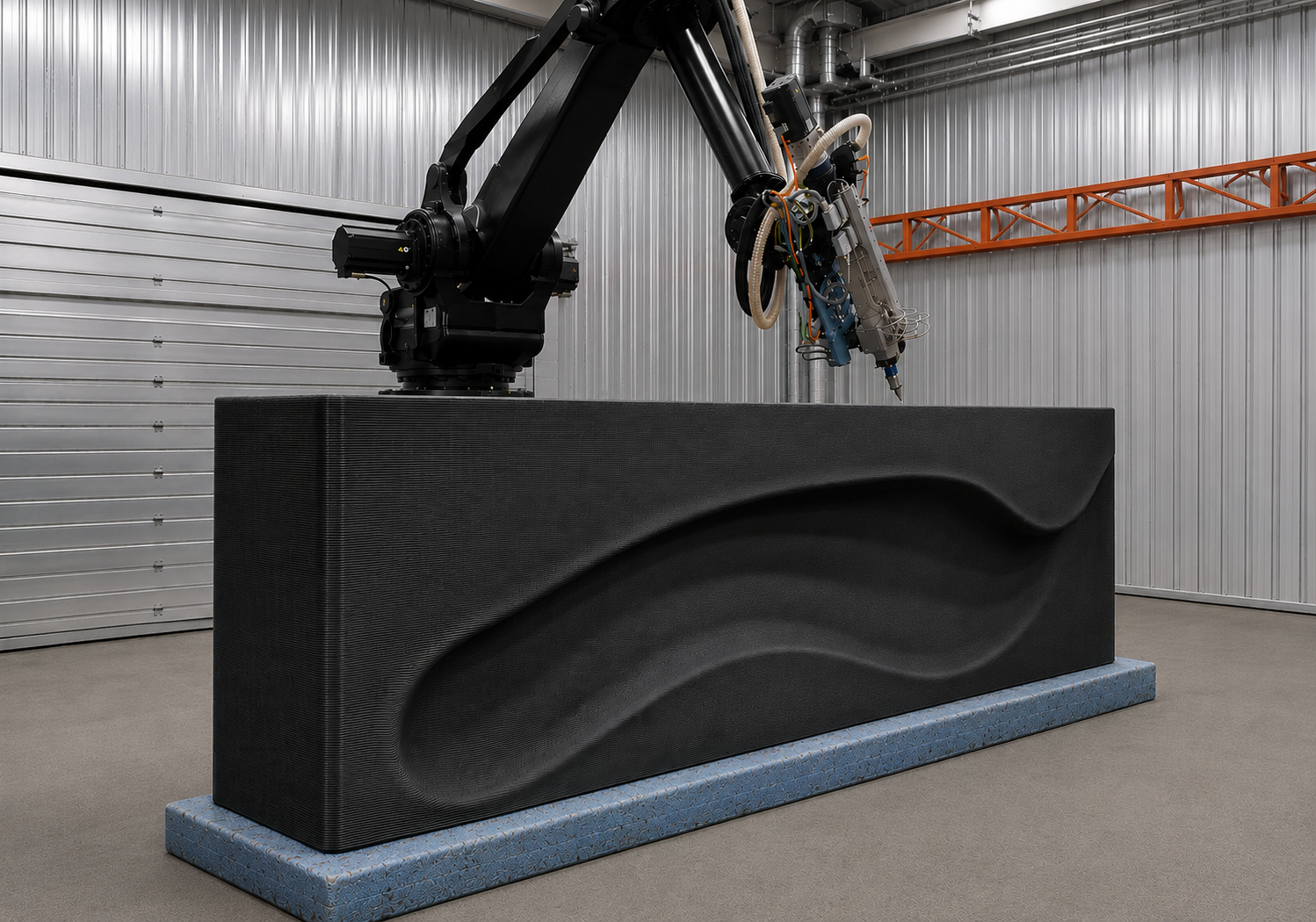
Use casesAerospace moulds & tooling
LFAM · aerospace tooling

The mould is the bottleneck. Print it.

An aerospace composite part takes hours to lay up and cure. The mould it cures on takes weeks to machine from a solid billet — and most of that billet ends up as chips. Large-format additive manufacturing builds the mould true to the surface geometry, using only the material that's structurally required. The slicer is the difference between that promise and a warped tool face.

Aerospace mould production with LFAM

The problem.

Traditional mould production for aerospace composites follows a painful sequence: machine a pattern, cast or machine the mould from it, iterate on fit, then wait. Lead times are measured in weeks. Material waste is enormous — a metre-scale autoclave mould machined from a solid block can throw away 80% of the stock as swarf. And if the part design changes, the mould starts over.

LFAM — large-format pellet extrusion on a robotic arm or gantry — eliminates the pattern stage entirely. You print a near-net mould, machine only the tool face, and cure composites on it. But the toolpath quality determines everything downstream: dimensional accuracy under autoclave temperature and pressure, internal stiffener placement for thermal stability, and whether the surface needs hours of finishing or minutes.

Most slicers treat a mould like any other part: flat layers, uniform infill, no awareness that this geometry will be loaded thermally at 180 °C under six bar of pressure. The result is warpage, over-machining, and moulds that don't hold tolerance through the cure cycle.

What an automated pipeline produces.

Surface-aware path planning

The tool face gets optimized toolpaths — minimal stair-stepping on the mould surface so CNC finishing removes millimetres, not centimetres.

Structural stiffener generation

Internal ribs and stiffener geometry placed automatically based on mould dimensions and thermal load, not hand-modelled in CAD.

Thermal-stability-aware infill

Infill density and bead orientation chosen to minimize CTE mismatch across the mould body — the tool holds shape through the cure cycle.

Carbon-fiber-reinforced materials

Path planning tuned for CF-reinforced pellet compounds like Dahltram C-250CF — autoclave-rated to 135 °C, dimensionally stable, recyclable.

Days instead of weeks

Print the mould body in a shift, machine the tool face the next day. No pattern stage, no multi-step casting, no six-week dependency on an external tool shop.

Robot-native output

Motion programs for the LFAM cell you already run — KUKA, ABB, Fanuc, gantry — not a proprietary format that locks you to one vendor.

Why the slicer matters here more than anywhere else.

A printed mould is not an end-use part — it's a manufacturing tool that has to survive thermal cycling, vacuum pressure, and autoclave conditions while holding micron-level surface tolerance. Every path-planning decision echoes downstream: bead orientation affects CTE, layer timing affects crystallinity, and surface quality determines machining cost.

This is exactly where automated, multi-axis-native slicing earns its keep. The slicer decomposes the mould into functional regions — tool face, stiffeners, base — and assigns the right strategy to each. No manual parameter tuning per feature. No trial-and-error on a metre-scale part that takes twelve hours to print. Get the toolpath right the first time, because the cost of a failed mould isn't a kilogram of wasted pellets — it's a week of lost schedule.

Specs.

Process
Large-format pellet extrusion (LFAM)
Hardware
Robotic LFAM cells; large-format gantry systems
Materials
CF-reinforced thermoplastics (Dahltram C-250CF, Techmer HiFill, etc.); GF-reinforced compounds
Inputs
Mould surface STEP, composite layup envelope, autoclave parameters
Outputs
Multi-axis toolpath with stiffener geometry, robot motion program, process log
Industries
Aerospace composite tooling, defence, space, motorsport
← Previous
Continuous-fiber composites
Next
Patient-specific medical devices →

Spending weeks on moulds that should take days?

Send us your mould geometry and the autoclave spec. We'll show you what an LFAM toolpath optimized for thermal stability and surface finish looks like.