Flexam Toolpath Editor opens in Early Access
The Editor is now open to everyone, bringing existing machine code and its 3D toolpath into one place for local inspection and editing.
A wider invitation to try the Editor
On 22 September, we opened Flexam Toolpath Editor to everyone in Early Access. It follows the private-access stage we introduced in July, but now gives a wider group of people the opportunity to try the workflow. The public offer includes free access and AI credits. We wanted people who work with additive-manufacturing machine code to see how the Editor fits the inspection and editing step in their own process.
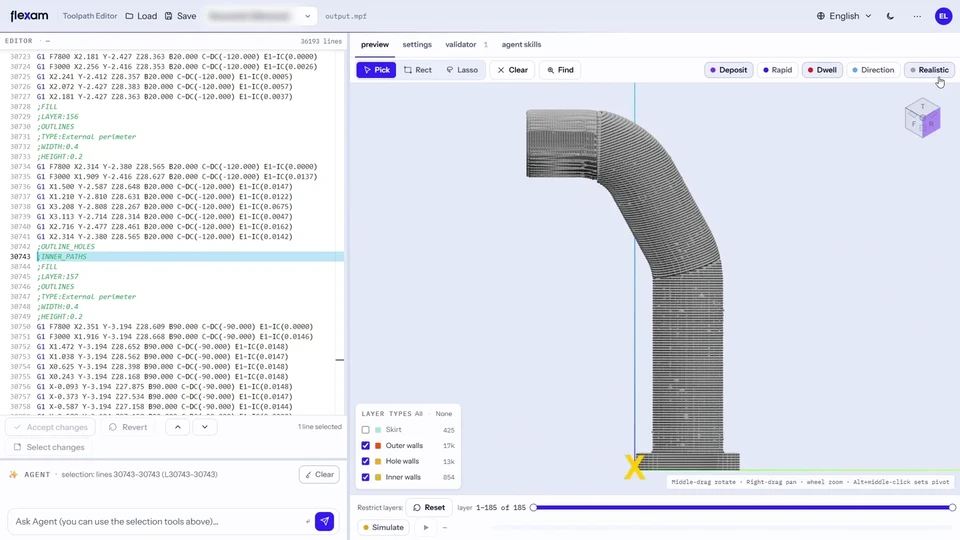
The starting point is the code that already exists after preparation in a slicer or CAM system. An engineer may want to look closely at one section without losing the relationship to the surrounding path. Reading the file and looking at the movement are two ways of examining that same job. The Editor brings those views together so that a local question can be considered in context.
From an existing file to a local change
The September demonstration begins with machine code and its toolpath displayed in 3D. The user can inspect the path and select the section that needs attention. Selection gives the edit a concrete location, rather than treating the file only as a long sequence of text. That is especially useful when the person reviewing a change wants to understand where it sits on the part.
Editing can be done manually, or the user can ask the AI agent for help with a selected change. The next step is still to review what changed in the code and the path. AI assistance is part of this working environment, rather than a reason to skip that review. The video accompanying the announcement shows how these steps are presented in the interface.
Learning from real preparation work
Opening Early Access also gives us a broader opportunity to learn which parts of the workflow need attention. A useful example begins with the file someone is working on and the adjustment they want to make. We are interested in where the selection, editing or review becomes difficult. That kind of feedback helps connect a product improvement with a task that actually needs doing.
This announcement is about access to an early product and the workflow we are inviting people to try. A program still belongs to the machine and manufacturing process for which it is intended. The engineer reviewing it needs to retain that context when deciding what to do with an exported change. If you work with generated machine code, the demonstration and product page provide a starting point for exploring the Editor yourself.